
Disease Prevention and Diagnosis Using AI
Awaji Island’s population decline is at the same rate as the rest of Japan, or perhaps even faster. Everyone is aware that addressing the declining birthrate and aging population may be Japan’s biggest challenge. The government is taking various measures to address this issue, including the introduction of AI and IT technologies to address issues arising from labor shortages and an aging population. This policy is known as the Society 5 Plan (model diagram below, taken from the Cabinet Office’s Science and Technology Policy). Representative examples include the idea that in order to care for the elderly in rural areas experiencing population decline, it is best to have people live in urban areas as much as possible, and the establishment of a digital communication network to quickly identify issues faced by elderly people living alone.
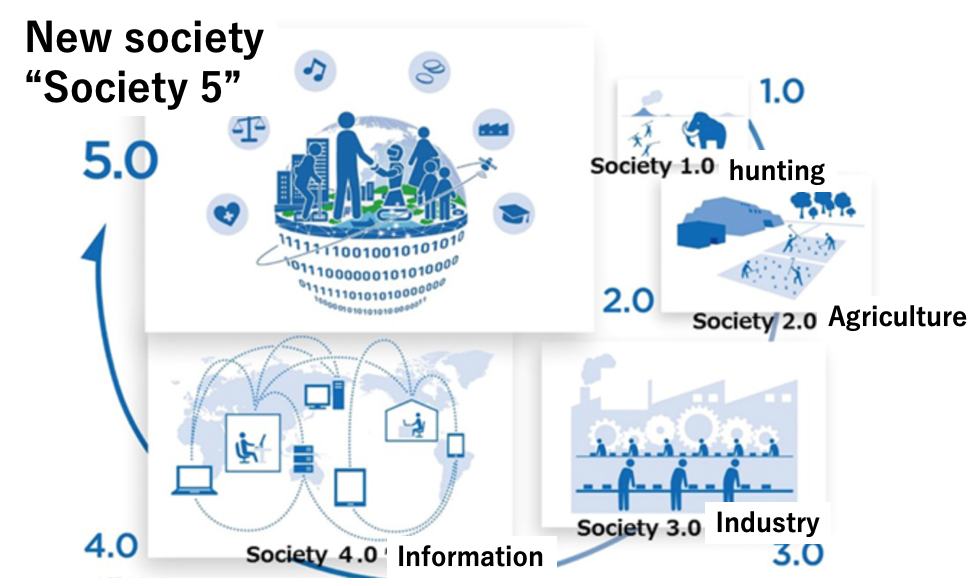
Fig. Society 5 proposed by the Japanese government.
If we could medically predict each individual’s future health status, it would be possible to avoid health risks associated with the health issues facing the elderly. How advanced is this research? Recently, the British journal Nature reported the results of a new program developed and analyzed using health history data from 400,000 people registered in the UK Biobank (Learning the natural history of human disease with generative transformers, by A. Shmatko, et al. Nature (2025) vol. 647 Nov. 6th). This program is said to be able to predict a person’s future susceptibility to disease. The accuracy of the predictions was verified using a similar database of 1.9 million people in Denmark, demonstrating high accuracy. The program, called Delphi-2M, is said to be able to predict the patient’s progress and future changes in disease status for over 1,000 diseases. It also claims to be able to predict and avoid future health problems in healthy individuals by pre-disease prediction.
Using the AI program perplexity, we investigated the extent to which AI-based analysis has progressed in health checkups and other procedures, as well as its accuracy rate.
AI is already being widely used to analyze medical conditions. Applications that have garnered particular attention include cancer diagnosis and abnormalities in the cerebrovascular system. Cancer lesions are excised early, and pathologists analyze the cells for abnormalities under a microscope. The degree of malignancy and future predictions are based on the cell’s morphology. This cell morphology data allows AI to predict the future. The results are said to be comparable to or even better than those of doctors. MRI technology can visualize blood vessels in the brain, allowing for the visual identification of abnormalities in blood vessel morphology and blockages. AI is also effective in this analysis. The accuracy of such diagnoses by specialists and non-specialists has also been compared. While lower than specialists, the accuracy rate is about the same, at around 50%, compared to non-specialists. At this stage, all research is considered to be at a level that only assists doctors’ judgments.
Yuval Noah Harari’s best-selling book, Homo Deus, introduces numerous advances and applications of AI and big data-based technologies. Harari argues that there is a scientific inevitability behind phenomena on Earth and that their mechanisms are logical. This logic is called an algorithm, and if we can decipher the algorithm, we can make AI understand it, and by fitting a small chip into the device, it will be possible to predict what will happen next based on what is currently happening. This kind of society (called Society 5 by the Japanese Government) may soon become commonplace. When that happens, it may also solve many of the problems of a society with a declining birthrate and aging population.