
What is Needed to Develop the Human Resources Necessary for Regional Revitalization? (2)
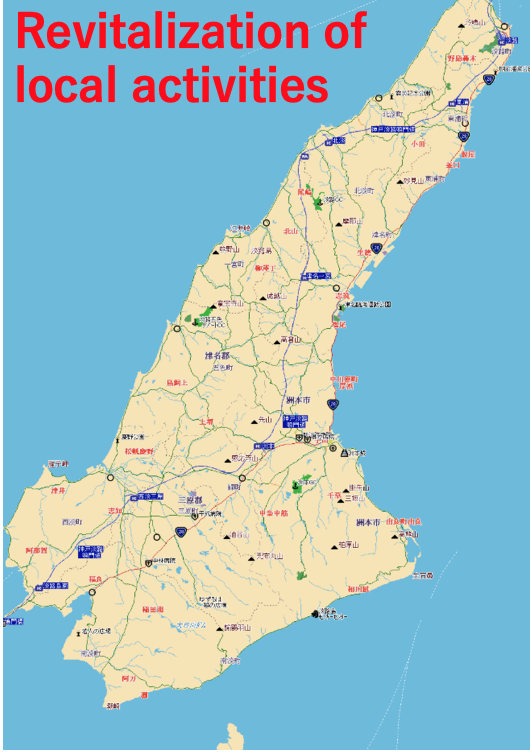
As noted in a previous report, regional revitalization requires personnel with the ability to address the unique circumstances of the region being revitalized and a love for their hometown. For example, Awaji Island, home to a special clay, has been famous as a roof tile production area since the Meiji era. Awaji Island’s decorative onigawara (rice tile) roofing tiles are truly impressive, dazzling in their luster and impact. It seems important to preserve their artistic value while exploring new markets. Awajishima is also famous for its incense production, made from cedar leaves harvested in Tokushima. While the scent of incense may seem old-fashioned, I believe there are many new sales channels for adding fragrance to a daily life. These examples clearly show that utilizing traditional products and expanding sales channels are essential for regional revitalization, and business development requires the use of current market analysis and IT.
Each region in Japan has its own unique traditional industry, and revitalizing these is undoubtedly one path to regional revitalization. Agriculture and fisheries are found in rural areas but not in urban areas. Industrial development could also center around these. How can we cultivate the talent to drive new regional industrial development?
Many professional graduate schools have already been established, primarily at regional national universities, to train talent who understand the unique circumstances of rural areas and have the ability to develop them. To further support this trend, the Cabinet Office has established subsidies for regional university-level human resource development for regional revitalization. While professional graduate schools do not require students to submit academic papers with specialized content like traditional graduate schools, they do require students to present a project that identifies and solves a problem after completing the two-year coursework required for graduation. Against this backdrop, regional national universities such as Kochi University, Kagawa University, Hokkaido University, and Yamagata University are putting significant effort into this endeavor. Meanwhile, urban universities like Rikkyo University and Kyoto University have also established graduate schools to train talent for regional revitalization.
Let’s take a look at the case of Kagawa University in particular. The Graduate School of Economics has established a Graduate School of Regional Management, with the aim of cultivating talent who can revitalize local businesses and develop solutions to local problems, as well as analyze these issues.
The list of master’s projects for 2023 is shown on the website, as shown below (From HP of Graduate School of Economics of Kagawa University).
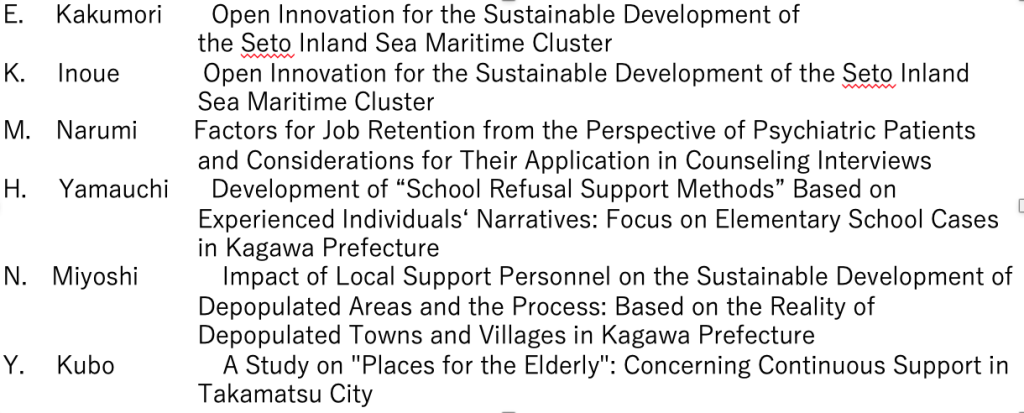
The projects list raises issues that are rooted in the local community and aims to solve them. Few are business-oriented. Rather, the issues raised are of universal nature, with many of them being challenges that every region faces. The university encourages students to pursue employment in the civil service, tourism, or local companies after graduation. A notable feature is that many students balance their studies with their current jobs, and the benefits of exchanging people from different fields are also touted.
Those who have studied regional revitalization theoretically and developed the ability to communicate with people from a wide range of fields are expected to make significant contributions.