

What is needed to develop the human resources necessary for regional revitalization? (1)
In rural areas where the birthrate is declining and the population is aging, what is needed and how to stem this trend is perhaps Japan’s biggest challenge today. The only area where population decline is stagnant is the Tokyo area. The percentage of people aged 65 or older is around 30% on average across Japan. Even in Kobe City, the population is falling below 1 million, and its population is declining and aging (29%, estimated from the Basic Resident Register). On Awaji Island, people aged 65 or older account for approximately 38% of the total population, significantly higher than the Japanese average, and is expected to approach 50% by around 2030. Around 1947, the island’s total population was nearly 220,000, but has since fallen to 140,000.
What should be done to stem population decline is a problem faced everywhere. Here in Awaji City, population decline halted about two years ago, with an increase of around 100 people last year (though the overall population is still declining in the island total.). This is likely related to the fact that Pasona Co. has relocated its headquarters in Awaji city, and that the number of young employees has increased by around 1,000 over the past few years. The fact that Pasona Co. has no operations in the remaining two cities on Awaji Island (Sumoto and Minamiawaji), where the population is declining and aging as usual, supports this assumption.
To address the issue of young people moving to Tokyo and the aging of the population, it is essential for local communities to create attractive employment opportunities that welcome young people. So, what is Pasona Co. doing on Awaji Island? I would like to briefly introduce it here.
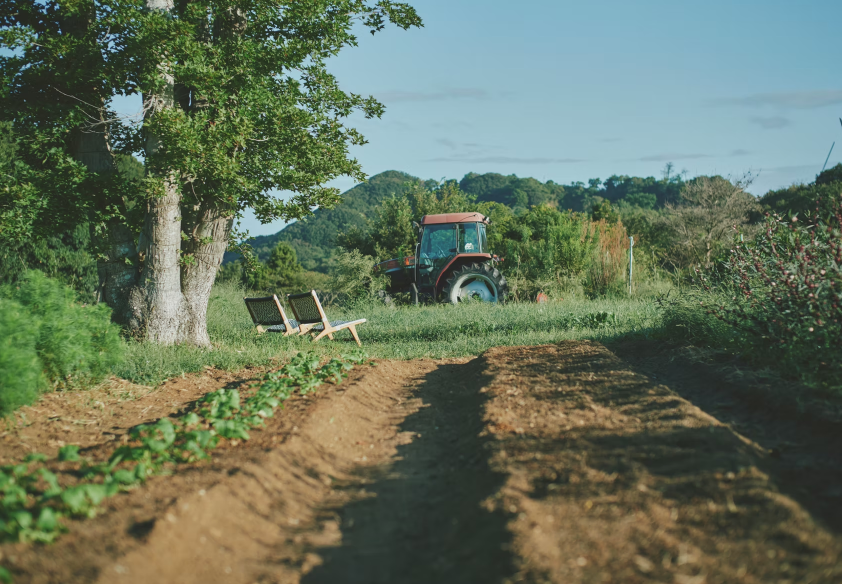
Fig. Abandoned farm land was changed to agriculture field like this.
As mentioned previously in this column (see the news on this website from November 17, 2023), unraveling Awaji Island’s 1,000-year history and examining how it developed into its current industry leads to the island’s overall tourist location. During the period of high economic growth and heavy industry in the Showa and Heisei eras, Sanyo Electric and Panasonic had factories in Awaji, and commuter trains ran on the island. Now, these industries left the island mostly, and then tourism is considered necessary to complement the 1,000-year-old fishing and agriculture industries. It has been more than 10 years since Hyogo Prefecture proposed tourism as the Whole Island Project, which turned the entire island of Awaji into a park. Awaji Island is home to a creation myth, and the Kojiki records that Japan began here are shared by the Japanese people and have been a key part of Awaji tourism since ancient times.
However, this alone is not enough to create a major tourist destination. Preserving Awaji Island’s natural environment is essential as a foundation for current tourist destinations. Restoring Awaji Island’s agriculture and fishing industries to a certain extent, even as tourism becomes a new main industry, is an important requirement. In light of this, Pasona Co. has been working for about 10 years to revive agriculture, particularly by training young people to work in agriculture. Pasona Co. has an organization called the Awaji Agricultural Support Team (http://www.pasona-nouentai.co.jp/agri-uni/awaji.php). By utilizing the island’s many abandoned farmlands, Nouentai is training young people to take up farming and promoting new initiatives in circular agriculture. They are also working to link agriculture with tourism (https://pasona-nouentai.co.jp/awaji_nlr/). Furthermore, to allow city dwellers to share the joy of farming and harvesting, they are building accommodation facilities and restaurants adjacent to the farmland (see the photos)(https://www.awaji-nlr.com/). Food waste used at these facilities is collected and turned into compost, which is recycled as an energy and nutrient source. Currently, they aim to convert a significant amount of abandoned farmland into vineyards and produce wine. However, there is one major problem with these efforts. Much of the abandoned farmland was originally rice paddy, and its use is limited to agriculture. Therefore, there are restrictions on converting abandoned farmland into tourism-related facilities or restaurants, making this legally difficult. Relaxing these restrictions is apparently a similar issue in many regions outside of Awaji Island.


Fig. New accommodation facilities (top) and a restaurant have been built next to the agriculture field to share agriculture with the people from big cities like Kobe and Osaka.
Pasona’s corporate philosophy is to contribute to social welfare, and its business is to support social issues in various ways. In addition to this philosophy, the company has added the unique goal of cultural creation. Cultural creation is broad, specifically aiming to promote the arts, including music, painting, and crafts. In line with this goal, performances such as ballet, opera, and musicals are already taking place, as well as plays and rakugo performances. Theaters have been secured for these purposes, and construction of a new opera house is also underway. Those involved in these artistic and performing arts activities generally face unstable employment. This situation reached a peak during the coronavirus pandemic. At the time, Pasona Co. hired artists who had lost their jobs and were struggling to continue working, enabling them to continue their artistic activities. This trend continues to this day. A ballerina evacuated from Ukraine is also working there. Through these multifaceted activities, a groundbreaking initiative is underway, primarily in Awaji City, to expand residential areas attractive to young people and young families. In addition to supporting Pasona’s headquarters, these various activities are creating new opportunities for Awaji Island’s declining employment. It is also aiming to become a model for addressing the declining birthrate and aging population issues that are occurring throughout Japan and the world. In fact, in 2023, an American researcher from the University of California studying regional revitalization came to observe Pasona’s activities on Awaji Island.

Fig. Ballet performance at Awaji Seikaiha theater with ballerina from Ukraine.